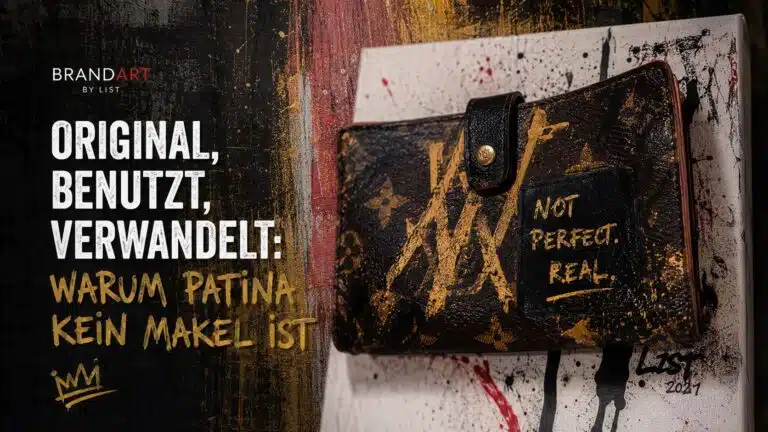

Before you read a single word, your nervous system has already taken sides. Logos They bypass language entirely—they appeal directly to instinct, the sense of belonging, and the fear of making the wrong choice. Louis Vuitton, Hermès, Prada: These symbols are not just signs; they are inherited certainties that your gut instinct responds to before your mind can intervene. That is why your own taste The louder the logo gets, the quieter it becomes. Keep reading—what follows will change the way you see both.

Before you even read a single word on a label, your brain has already made up its mind. A Louis Vuitton Monogram, a Hermès-Castle, a Dior-Serif—your nervous system reads these symbols before your conscious mind even enters the picture. That’s not a weakness. That’s *wiring*.
Logos and purchasing decisions are inextricably linked—not through logic, but through memory, texture, and accumulated desire. The Brand Psychology Luxury It operates beneath language, in the place where a flash of golden light triggers something ancient and certain.
Consistency as a perception enhancer isn't a marketing gimmick—it's the visual grammar your brain trusts *before* it thinks. Prada's Minimalism. Hermès’ ochre. These aren’t mere decisions. They’re orders.
BrandArt by LIST understands this instinct—and subverts it. It takes what your subconscious already loves and transforms it into something your conscious mind has never seen before. Obedience Ends. Art begins.
Brands speak a language we've never learned—and yet we speak it fluently: Recognition as Rhythm, Quality as a promise, price as silent proof.
A Louis Vuitton Monogram, a Hermès orange, a Dior silhouette—they don’t have to beg for trust; they’ve earned it, stitch by stitch, decade by decade. Social Validation That takes care of the rest: When everyone nods in agreement, hardly anyone doubts their own taste anymore.
There's a reason why you're looking for Hermès you act before you've finished thinking the thought through—recognition isn't a passive process; it's a reflex that has developed over the years well-deserved consistency has been etched into my memory. Repeated quality becomes instinct. Inherited trust becomes a matter of taste.
But there's a rebellious streak in this reflex: BrandArt Psychology Expose her. If List a Louis Vuitton or Prada By combining it with raw, painted canvas, he doesn't celebrate the logo—he questions it. Art and Brands They clash, and suddenly your own taste for luxury becomes visible, tangible, and open to question.
Social recognition has told you that this bag means something. The artwork asks: *What exactly?*
Every BrandArt creation transforms this inherited certainty into a conscious choice—not consumption, but a statement. Not confidence you borrow from a logo, but an identity that you shape yourself.
Price isn't just a number—it's a story we tell ourselves to avoid the unease of not knowing. We see four digits on a Hermès label and feel something changing—not a taste, but a sense of trust. The price whispers *quality, safety, belonging* before our hands even touch the leather.
Research confirms it: 86%: The Consumer equate higher prices with better quality—not because the stitching proved it, but because the number convinced them from the start. We base our judgment on a number. We let Prada's Pricing Structure tell us what beauty costs.
But BrandArt by List breaks this contract—takes Louis Vuitton, Dior, the whole gilded mythology, and asks: *What if the Cherish Your Freedom would distinguish you instead of your status?*

Somewhere between the first A Glimpse of Hermès And once the purchase is final, your own taste fades into the background—drowned out by the rush of recognition, the sense of belonging, the Fear of making the wrong choice.
That's not a weakness; it's biology cloaked in social armor. The logo doesn't just signal quality—it signals security, and over time, that security becomes a voice louder than your own.
When options pile up and decisions feel permanent, something quiet happens— your gut feeling Step back; your vision grows blurry, and The logo stands out. Not because the logo is correct. But because it feels *safe*. Fear doesn't give you any warning; it simply narrows your field of vision until a Louis Vuitton Monogram or how a Hermès stamp feels like certainty, encased in leather.
You'll stop asking, what you love. You start to ask yourself what you can defend. This shift—from desire to damage control—is the point where taste falls silent and branding fills the void. BrandArt by LIST knows this paralysis all too well. Every “Canvas meets Prada” creation is a provocation: choose boldly, choose personally, choose once—and let your choice speak for itself, without apology.
Taste, it turns out, is a quiet thing—easily drowned out by the clamor of approval. We don’t choose logos the way we choose lovers; we inherit them like language, like posture, like the neighborhood we swear we left behind long ago.
A Louis Vuitton Monogram, a Hermès saddle stitch, the cool geometry of Prada—that’s not jewelry. Those are statements. Belonging, rendered in leather and patent leather. BrandArt by LIST understands this language.
It doesn't fight against the symbol; it hijacks it, stretches it over raw canvas, and returns it—transformed— Dior Reborn somewhere between the quiet of a gallery and spray-painted concrete.
Your Taste He hasn't disappeared. He's just found a sharper tongue. Recognition has become the material. The logo, the brushstroke. The bag, the manifesto, that you carry.
If art is a Louis Vuitton Monogram or a Hermès logo When it is torn from its familiar setting and brought to the screen, something radical happens: the brand becomes visible—truly visible—for the first time.
Suddenly, the symbol is no longer a promise, no longer a sign of trust, no longer a silent command to your taste; it is an object, open-ended, ambiguous, which is waiting for your interpretation.
You have to decide for yourself again what you see—not what Prada, Dior, or the market have long since decided for you.
Every logo you've ever trusted was designed to blend into everyday life – and that's exactly where it lurks BrandArt by LIST on.
The moment a Louis Vuitton monogram leaves the context of a boutique, something happens. It ceases to be a symbol of permission. It becomes the question.
Suddenly, you’re reading the sign instead of obeying it. LIST tears Hermès, Prada, and Dior from their velvety pedestals and pins them onto raw canvas—where they come alive, visible, vulnerable, and full of contradictions.
The logo remains recognizable, yes. But Detection Without a Reflection – That is exactly where interpretation begins. Form becomes material. Symbol Becomes the Focus. You no longer just consume the brand—you question it.
That is the breakthrough that BrandArt achieves: Not destruction, but revelation. The symbol survives the ambush, but now it bears your gaze instead of hiding from it.
Tear a logo out of its overall context – and something irreversible happens: It stops giving orders and starts asking questions.
The Hermès H, the Vuitton Monogram, the Prada Triangle – Freed from the boutique lighting and the branded paper, they become open icons, raw material for reflection.
You are no longer a consumer who receives a message. You are a witness who reconstructs meaning.
BrandArt by List creates exactly this kind of rupture. The familiar logo appears on the screen, alongside color, alongside intention—and suddenly your gut feeling has to take over, without the brand’s permission.
Shape. Color. Weight. These are your tools now. No marketing team will tell you how to react. No barrier tape will dictate your feelings.
The logo is still alive, still pulsing—but you decide what it means.

Looking good isn't enough—a logo has to *work*, and the only way to really know that is to test it against reality.
A logo that just looks good is deceiving. Only reality will show whether it really works.
Show it to people who owe you nothing—no praise, no courtesy, no history.
Likert scales measure what sympathy obscures: Uniqueness, Appeal, Clarity.
Three words. That's all you need to know whether a logo speaks or remains silent.
BrandArt by LIST passes this test because it doesn't come out of a vacuum—it comes from the street, from the studio, from the tension between between Louis Vuitton and canvas, between Hermès and attitude.
Every element is intentional. Every color carries significance.
Check out your logo in black and white. Small. Large. On asphalt and hardwood floors.
If it works there—really works—then it doesn't just belong to you. Then it belongs to the movement.
Trust begins before you've even read a single word. A glance. An impression. Then your brain makes a judgment—faster than language, deeper than logic.
BrandArt by LIST understands this mechanism and, at the same time, breaks it down. No anonymous mass production. Not an empty symbol. Each One Is Unique – A Hermès Birkin against acrylic, a Louis Vuitton Monogram meets urban texture – carries a meaning that you *feel* before you can explain it.
Three Questions That Will Set You Free:
Taste isn't a weakness. It's your sharpest tool. Sharper than any logo. Wilder than any halo effect. *Yours.*

Logos give you a sense of security—but security isn't a choice; it's a shortcut. A Hermès or Louis Vuitton logo conveys competence before you even have a chance to form a thought. That's cognition, not taste.
But BrandArt by List picks up right where this automatic response ends—at the deliberate break. Ralf List takes Prada, Dior, and Louis Vuitton and transforms the item: Handbag Meets the Canvas, Asphalt meets hardwood floors; the street meets the gallery.
The result is no longer just a logo—it’s a one-of-a-kind creation, Handcrafted, hand-signed, one-of-a-kind. Brand strategy provides you with guidance. Brand art gives you an identity.
True positioning doesn’t come just from repetition, but from the courage to reinterpret a brand—through color, attitude, and form. The real question is never „What should it look like?” It is: What do you stand for? BrandArt is the answer on the body.
A logo can only simulate real emotions; it cannot replace them. It triggers psychological reactions, but your genuine feelings arise from experiences, consistency, and authentic brand behavior—not from a symbol alone.
Sooner than you think— as early as age two You recognize logos like McDonald’s or Nike. The conditioning begins quietly, before you can even speak. Your trust in brands was programmed before you were even allowed to make choices.
Yes, but not in the way you think: Men chase status symbols, while women are more responsive to aesthetics and details. Both are conditioned—just in different ways. Your taste is still *yours*.
Yes! In China, for example, you trust a personal recommendation from your network more than a logo. Close relationships trump abstract brand symbols there—the people around you matter more than any design symbol.
Yes—and it’s almost insultingly simple: I replace „Do I like the logo?” with „Does it work for the target audience?” This single shift in thinking shatters the learned trust and gives me back my ability to judge.
Your sense of style existed before the logo took it over. I’m not asking you to burn your Hermès or bury your Dior—I’m asking you to look more closely, to savor the moment longer, and to take your time when making decisions. True Style It isn't inherited from a monogram; it's unearthed from everything you've quietly noticed but never felt confident enough to name. Stop looking away. The most radical thing you can wear is a choice that is entirely your own, without any excuses.
 German German
 English
 Spanish
 French