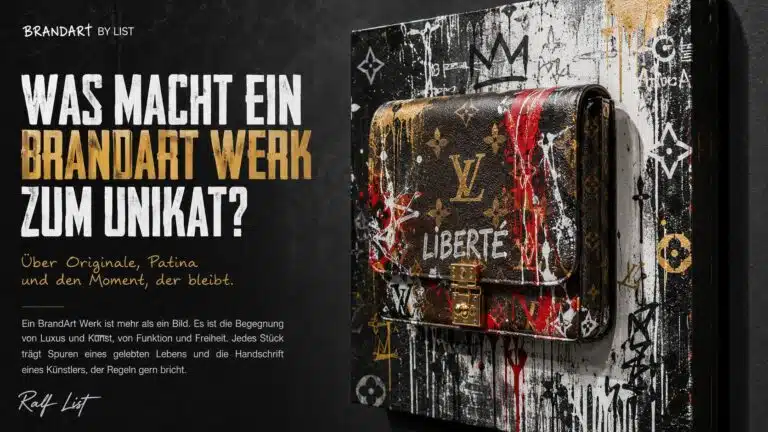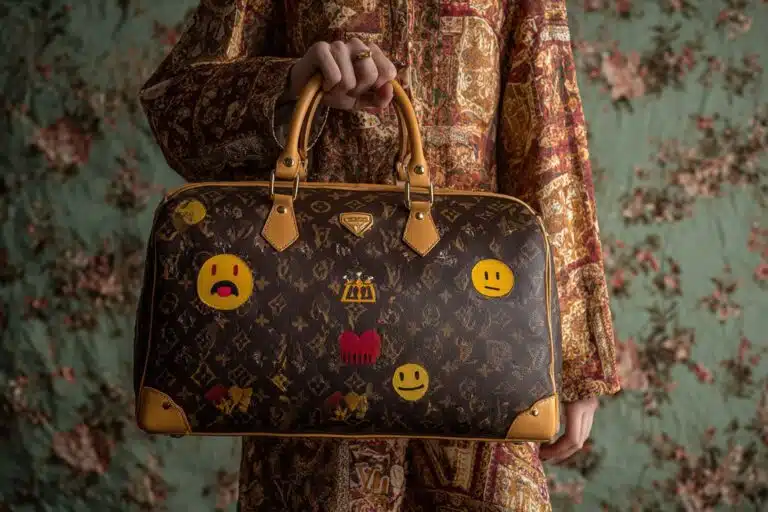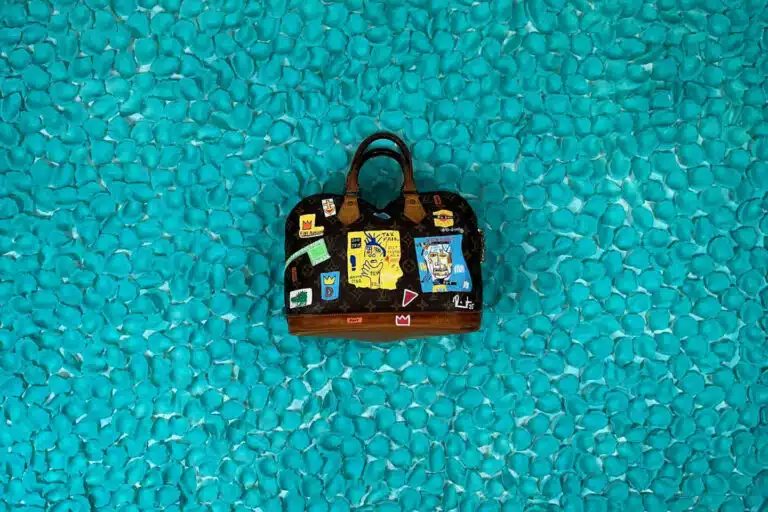
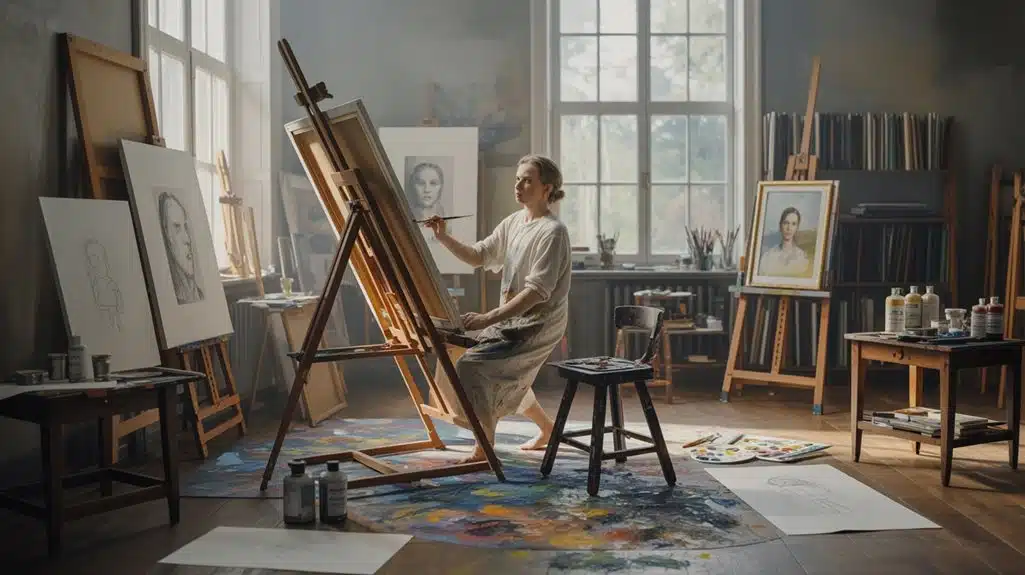
Each piece begins with a A thought that is so precise, ...that he cuts—long before I even have a paintbrush, a canvas, or a Hermès Bag I touch it. The idea comes first. Raw, unique, non-negotiable. I read the object like a manifesto: its patina, its curves, its cultural significance. Louis Vuitton, Prada, Dior—they carry a history that I reinterpret, never imitate. From the first impulse to the final brushstroke, every decision is deliberately. What follows shows exactly how.
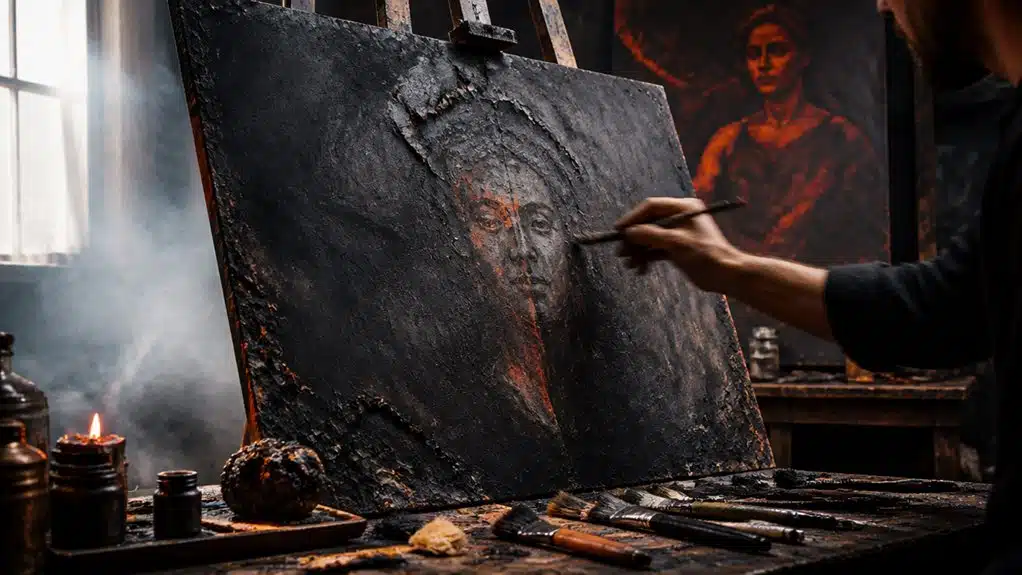
No briefing. No set plan. Just one object, an impulse, a truth that carves its own path. The creation of a work of art at BrandArt by List doesn't follow a blueprint—it follows the moment. A Hermès Straps is on the table. A blank canvas wait. What emerges in the process is neither predictable nor reproducible.
This artist’s studio report sounds intentionally different because the BrandArt production process is different. Ralf List doesn’t start with the end in mind—it starts with Curiosity, excitement and a deep respect for the material. A Louis Vuitton bag is not a blank canvas. It embodies history, style, and craftsmanship. The color meets decades of design.
No product is created here. A stance is formed here. Asphalt over hardwood. Energy over expectation. Freedom Over Form. The first thought is rarely the last—and that is precisely where the power lies.
Every object speaks to me before I make my first brushstroke—I read the curves of a Hermès flap, the Patina an aged Louis Vuitton monogram, the silence of a Prada leather piece that has known other hands.
Shape, color, material: that is the basic grammar. Then comes the feeling—the cultural resonance that such an object carries with it, whether it be desire, status, or memory—and that is exactly where my answer begins.
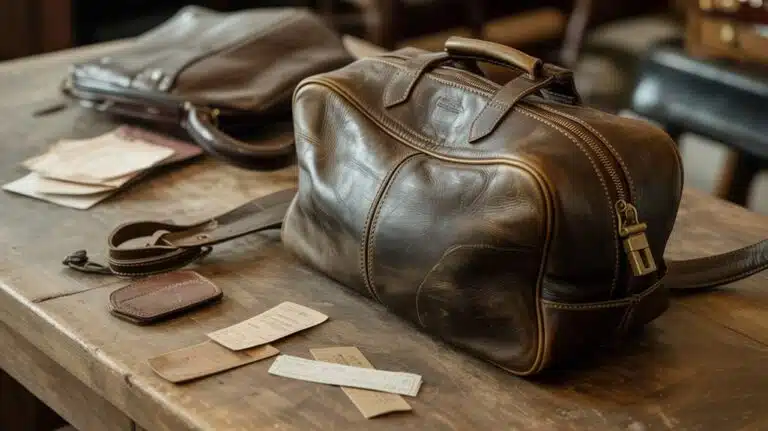
Before I even touch a bag, I take a moment to study it. Every contour tells a story. Every seam holds a memory. When it comes to art with luxury bags, it all begins with quiet attention—shape, color, material, traces. A Louis Vuitton tells her story in the Patina, a Hermès Leather It speaks through its texture and weight; a Prada strap shows me where hands have gripped it, where life has taken place.
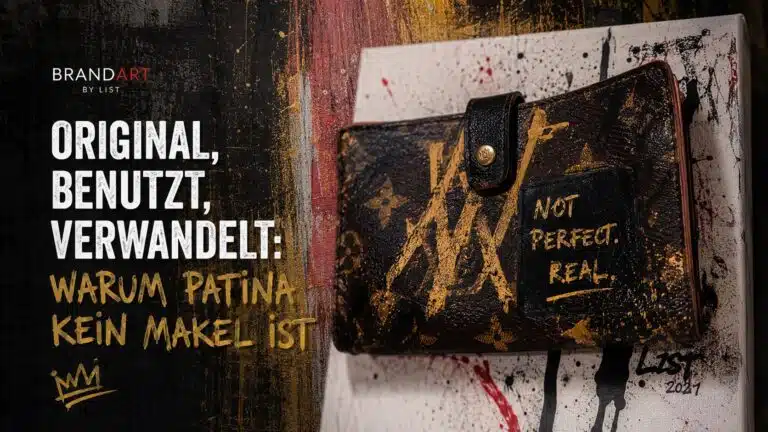
These marks are not flaws. They are invitations. I read the surface as a manifesto—changes in color as confessions, textures as witnesses. Ralf List Art does not come into being in spite of these traces, but precisely because of them. The object has already lived. My canvas responds to that – precise, deliberate, fearless. Transformation It doesn't start with the brush. It starts with the gaze.
As soon as I hold a bag in my hands, something happens before I even have time to think. A Hermès Leather speaks before I answer. A Louis Vuitton Monogram conjures up images—streets, longings, power dynamics—in milliseconds. The brain processes, before the mind passes judgment. Culturally Coded, with biographical elements, loaded immediately.
This first reading is no coincidence. It is the material for my work. Prada ensures precision. Dior carries desire. Every bag brings a collective memory with—asphalt over parquet, rebellion beneath elegance, history in every touch.
I read the object as if it were a manifesto: What does it feel? What does it recall? What does it challenge? Everything emerges from this initial, uncontrollable association—the composition, the color, the first brushstroke.

As soon as I Object Once I've read it—its story, its splendor, its quiet contradiction—the real work begins: the ratio between Canvas and to compose the object as if asphalt and hardwood flooring were coming together.
I wonder whether the canvas frames the object or challenges it, whether it whispers or screams—whether a reference to street art meets the legacy of Hermès or Dior and finds its tension precisely in that encounter.
Form, reference, proportion: three choices, one one-of-a-kind piece.
Between the first thought and the final brushstroke lies a decision that changes everything: How does the canvas relate to the subject? Format is no accident. It’s a matter of perspective. I make a conscious choice as to whether a Hermès bag dominates the visual space or whether it breathes—surrounded by space, tension, and silence.
The Rule of Thirds provides guidance, the golden ratio brings dignity. But BrandArt by LIST breaks rules only after they have been understood. Foreground, Middle Ground, Background – three zones, three truths.
A Louis Vuitton object in the center has a different effect than one anchored at the edge of the image—it almost seems to be fleeing. Proportion determines closeness and distance, calm and turmoil. Composition is not a technique. It is the language that exists before color speaks.
Every artistic concept needs an anchor—a cultural context that gives it substance before the first brushstroke touches the canvas. Pop Art. Street Art. Art History. These three fields are not styles—they are attitudes.
Warhol reproduced art to expose the truth. Street art took over walls to liberate. Both spoke the language of the street—with the precision of a manifesto.
At BrandArt by LIST, this very energy meets a Hermès Birkin or a Louis Vuitton Speedy—not as a tribute, but as a reinterpretation. Asphalt over parquet. The iconographic language of Dior or Prada is not imitated; it is subverted, alienated, and retold.
The motif emerges where Recognition of Rebellion Striking. Familiar. Disturbing. Unforgettable.
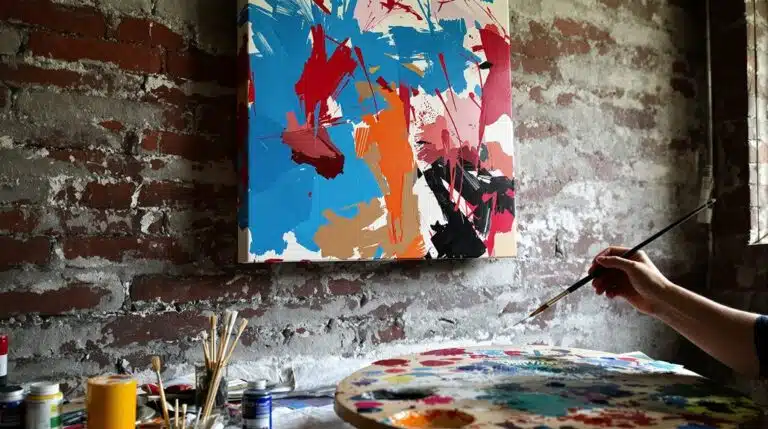
The canvas is not a blank slate—it’s a promise woven from fabric, tension, and texture, built layer upon layer like the identity of a city.
I work with overlapping planes and contrasts that clash: raw gesso meets the Louis Vuitton Monogram, a shade of Hermès orange stands out against the black background.
Overpainting isn't a mistake; it's a choice—every break in the image is an acknowledgment of what was there before it became what it is.
Anyone who sets up a screen makes decisions—about Silence, Tension, Order, and Rupture—before the first brushstroke touches the surface.
Breathe in the vast, tranquil expanses.
Small, dense areas draw the eye forward, restlessly, hungry for resolution.
I work with Layers, which lend depth – Foreground versus Background, Asphalt over hardwood floors.
A Hermès flap gives a composition a different look than a Louis Vuitton monogram; each shape carries its own weight.
Contrasts—big versus small, smooth versus rough, closed versus open—are not stylistic devices.
They embody attitude.
And then: the deliberate break.
The Diagonal, which shatters a rigid order.
The moment when a Prada silhouette encounters a gesture that no glossy magazine would ever have planned.
Order arises from the courage to break it.
Overpainting isn't a mistake—it's proof that a painting is alive. Every layer I apply over a previous one isn't a surrender, but a decision. A Louis Vuitton Monogram, an Hermès orange, a Prada black—they don't want perfection. They want truth.
I don't work toward a final product; I work my way through different states. The past never completely disappears: Color Noses, Traces of the original, a faint hint of color beneath—all of this is still present within the painting itself. Layer by layer Something emerges that looks as if it grew naturally, not as if it were built.
No Dior nail polish, no sidewalk, no canvas remains as it was. The brush doesn't correct—it transforms. And that is precisely where the freedom lies: in the a courageous, gradual process of becoming.
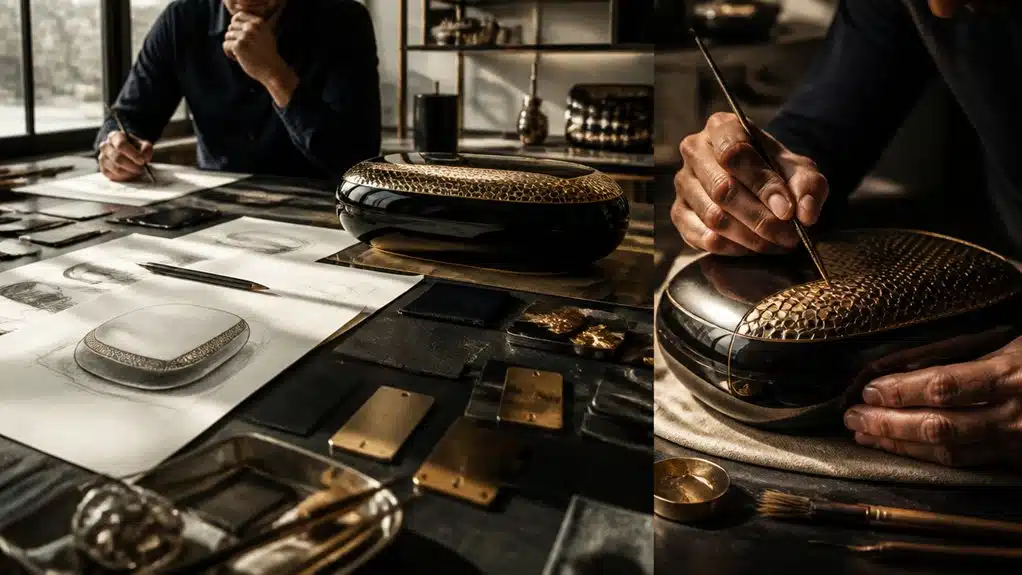
Where the piece ends up is what matters most—not just on the canvas, but in the interplay between color, form, and the unmistakable character of a Hermès or Dior. I treat every attachment as a choreographed gesture: precise, deliberately, as tense as the moment before the first brushstroke.
If Object and Image When we truly talk to one another, what emerges isn't just decoration—it's a message, raw and refined at the same time.
The location of a BrandArt facility is no trivial matter—it is the final artistic decision. Where you place a piece of furniture determines whether it “breathes” or “suffocates.” In the living room, it belongs across the sofa – An eye-catcher, a conversation starter, a declaration of power. The Image center at 150 cm. Non-negotiable.
White space is not nothing—it is pressure, tension, the pause before the next sentence. Give the work a free radius equal to 1.5 times its largest dimension. Let it dominate.
The grip follows the stance: sturdy anchors For heavy frames, museum-grade wax for sculptures meant to look untouched. A level. A clean cut. No compromises during installation—because a Louis Vuitton, a Hermès, or a Prada deserves a wall that can hold it up.
Not every object hanging next to a picture, speaks with him—most people just exchange polite, meaningless small talk.
A Hermès, a Vuitton, a Dior: They wear Iconography, History, Weight. But Weight alone does not generate a dialog. The object must Part of the story depicted in the image become—legible, intentional, inevitable.
This is how I work: Form, Material, and Symbolism maintain the same semantic direction, no competing noise, no decorative politeness. When a Prada bag appears in the visual context, it isn't on display—it speaks.
The moment when viewers can no longer distinguish between the image and the object is precisely the moment I am working toward. Not a silent coexistence. Not an illustration. Just a work that speaks for itself— loud, coherent, lively.
Even when the final brushstroke is in place, the work isn't finished yet—it's still waiting for its signature. The Call Number is not a formal act; it is the final conscious gesture that transforms authorship into color. I set it bottom right – Convention broken, tradition upheld.
Then comes the Back: Title, Year, Medium, Dimensions. No red tape. Evidence-based reasoning. A Louis Vuitton Bag On canvas, a Hermès piece as a base, a Prada fragment reimagined—each of these one-of-a-kind pieces deserves its own certificate of authenticity.
The Certificate of Authenticity This rounds out the whole process: name, image, signature, date. Documentation is a sign of respect for the work, the collector, and history. Take photos of the front and back before the piece changes hands—the lighting must be right, and the frame must speak for itself. The signature, certificate, and archive together form the triad of authenticity. No work is truly complete until it is documented who brought it into the world.

It all starts in the mind—long before a brush, canvas, or bag is even touched. The idea grows quietly, sometimes over weeks, like paint drying undisturbed. No coincidence. No improvisation. Just vision.
No coincidence. No improvisation. Just an idea that grows quietly—long before the hands get to work.
Three truths about the origin of every BrandArt piece:
Prada meets asphalt. Dior encounters the raw sketchbook. From this tension emerges something third—neither a fashion item nor a classical painting, but a manifesto on canvas and leather.
Every work visibly bears the mark of the time in which it was created. This is not art about Luxury. That is Luxury, Reimagined.
The final brushstroke is not a sign of waning effort—it is a statement of intent. I decide when a work is complete—not the clock, not the market, not expectations. That moment—when the brush is lifted from the canvas, Hermès Birkin including, Louis Vuitton Monogram that breathes through layered pigment—is pure intention made visible.
BrandArt by LIST thrives in the moment. Between decision, discipline, and freedom. The Prada Silhouette It doesn't disappear under the paint—it transforms, becoming wilder, more honest, more alive. Asphalt Over Parquet Flooring. Gallery around the corner. Both—always both.
Drawing a line under something isn’t a sign of exhaustion—it’s a commitment, a culmination, freedom. When I set down my brush on a Dior piece, I’m not finished. I let it go—into your hands, your story, your movement. This is not a product. That's a decision you have to make.
I can't give you an exact average time—that information isn't publicly available. Every BrandArt piece is one-of-a-kind, and true art can't be measured in hours.
Whether it's new or used—that remains to be seen. What I can tell you is that Ralf List works with authentic luxury properties. It is their authenticity that truly brings every BrandArt piece to life.
Yes, you can bring your own bag—that beloved, well-worn beauty of yours—and I’ll transform it into a stunning 1/1 BrandArt original, where the personal story behind your piece drives the artistic vision.
Every BrandArt piece comes with a hand-signed certificate of authenticity that I issue personally. It lists the title, materials, year of creation, and a unique serial number—so you can be sure that your one-of-a-kind piece is truly unique and officially certified.
Forget dusty vaults—BrandArt is breaking out and taking the world by storm Germany (NordArt Büdelsdorf), which Czech Republic (Mikulov), France, Italy, Sweden and the Switzerland. I'd say this is less of a „gallery“ and more like *global liberation in leather and canvas*.
The final brushstroke isn't an ending—it's a statement. Some people think, BrandArt is decoration; it isn't. It is Confrontation: a Louis Vuitton, a Hermès, a Dior, deprived of their obedience and rebuilt as a testament. I don't finish a work when it looks finished. I finish it when it ultimately means something. That's the difference between doing and saying. And I'm always saying something.
 German German
  English
 Spanish
 French