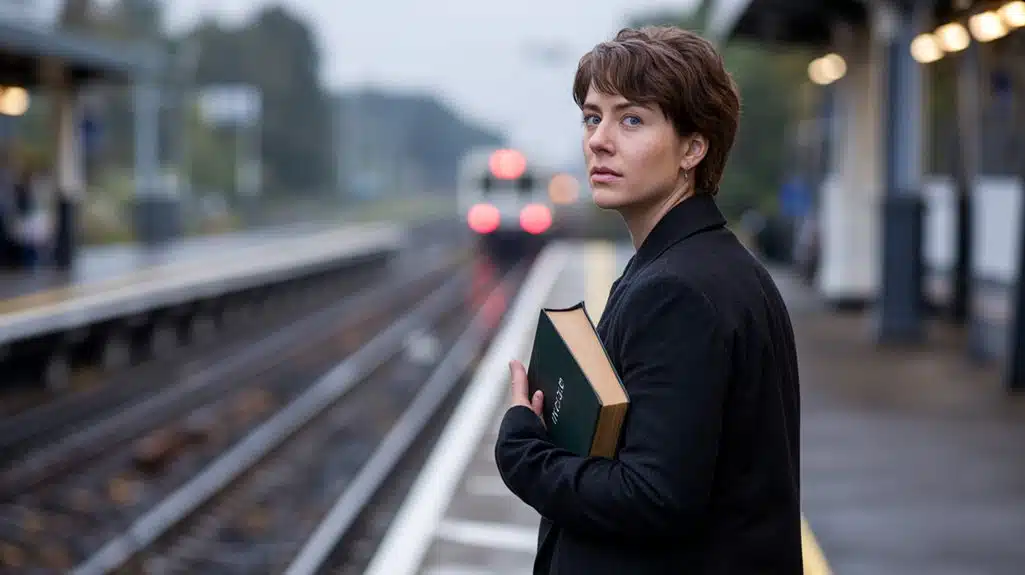
A finished image I’ve already formed an opinion in my head—and I refuse to judge the work before it speaks for itself. If I know how it ends, I stop listening. The screen stops surprising me. That Hermès Leather Stop negotiating. What I want is the moment when Louis Vuitton yields to the brushstroke, when Dior exhales without explaining anything. Right there is true – unplanned, undeniable, irrevocable. Keep going, and I'll show you exactly how this moment unfolds.
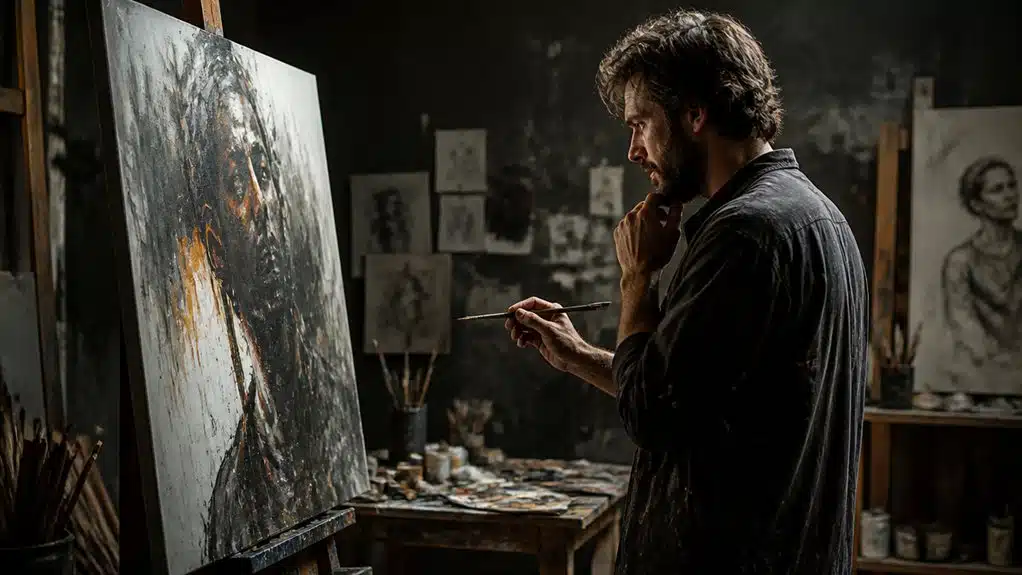
Anyone who already knows the ending before the story begins has cheated themselves. A a clear picture in one's mind is not guidance—it is a cage. Mental imagery is not neutral; it filters, distorts, and makes preliminary decisions before the brush even touches the canvas.
A preconceived image in your mind is not a compass—it is a cage.
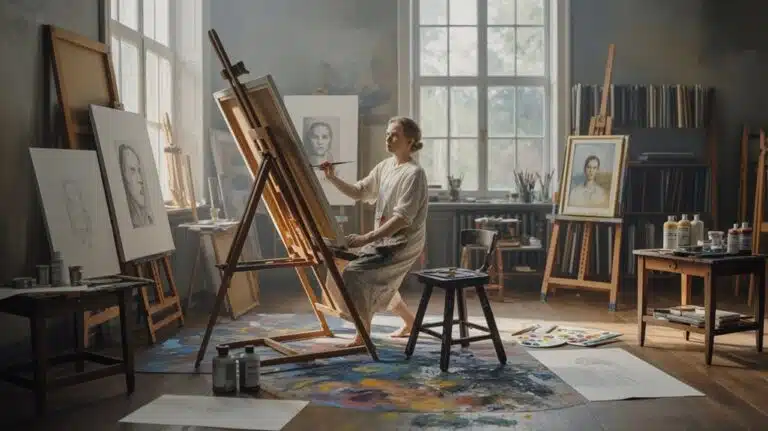
I work without a set plan. Art without a fixed plan is not a loss of control—it is precision within freedom. When a Louis Vuitton Bag meets raw canvas when Hermès Leather beside Spray paint breathes, something emerges that no mental image could have foreseen.
The artistic process of chance is not a flaw in the system. It is the system.
Those who are already broken inside no longer see what is real coming their way. Prada becomes a projection. Dior as expected. But BrandArt by LIST lives precisely where expectations are shattered—in the open moment, in the unwritten outcome, in the here and now.
Before I make my first brushstroke, one thing is certain for me: the conflict, not the solution.
I know what kind of suspense I want to create—that Louis Vuitton Monogram Raw gesture meets Hermès silk—a clash of spray-can instinct—but the ending remains deliberately open-ended.
Structure is my framework, not my judgment.
Planning is the framework, not the painting. In the BrandArt Studio What is tangible is certain: the Canvas, the bag, the size. A Louis Vuitton, a Hermès, a Dior—each object carries its own story, its own weight. That is the foundation. But the foundation is not the direction.
Dimensions, walls, light—I know the parameters before I make the first stroke. What I don’t know is the truth of the work. The creation of abstract art thrives precisely in this gap between control and the loss of creative control—the moment when the planned ends and the essence begins. Certainty is the framework. Suspense is everything it cannot contain.
Security isn't the enemy—but it's not a work of art, either. I know which bag I'll take: one Hermès, a Vuitton, a Dior—each one already full of stories. I know, where the canvas begins.
What I don't know—and deliberately don't want to know—is, where the paint runs. Whether asphalt triumphs over hardwood floors. Whether the work whispers or screams. This openness is not a weakness; it is the very structure itself. Any predetermined decision would kill the tension before it even comes to life. The finished work emerges between Control, Chance, and the Moment, where they both stop arguing. I plan the framework—but the interior remains open, breathes, finds its own way.
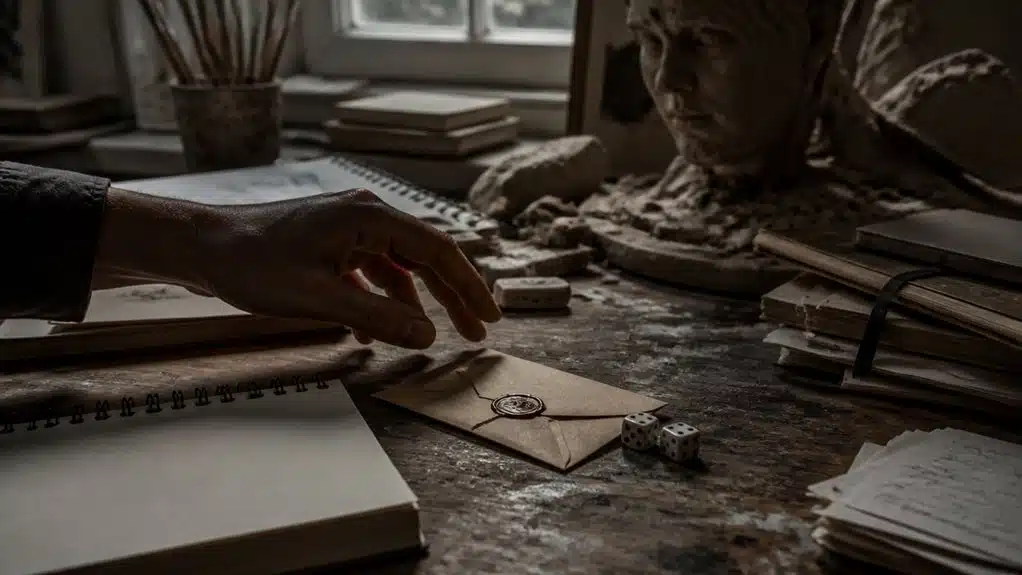
Sometimes the Coincidence into my work before I even realize it—an unexpected Color gradient Across canvas and leather, a trace that remains because it chose to remain.
What looks like a mistake is often the most honest decision in the entire process. Chance is not a disruptor; it’s my quietest, wildest collaborator.
Color cannot be commanded—it flows, breaks, and blooms on leather and canvas like a statement that no one planned.
If I Decalcomania when I let loose on a Hermès surface, the following happens: Marbling, which no brush could ever paint.
Salt crystals on wet acrylic paint—efflorescence, wild and precise at the same time.
Drops of paint that I swing rather than guide leave trails across Louis Vuitton Canvas like tire tracks on parquet flooring.
Smooth surfaces of Prada or Dior They react differently than canvas—they resist, negotiate, and surprise.
That's not a mistake. That's the real moment.
Three colors are enough. Repetition builds suspense.
Every trace, every path, every crystalline reaction is a statement formulated by the material itself—I merely respond.
That's exactly what makes Every piece is one-of-a-kind.
The things I didn't plan still belong to me—sometimes more than anything I've ever controlled.
A Error It's not a step backward. It's a detour that I couldn't see coming.
When paint runs, when a cut is too deep, when the Hermès leather behaves differently than expected—then something opens up. A Direction, who wouldn't have been able to come up with a plan. I follow her. That's not a weakness; it's a stance.
BrandArt by LIST thrives right there: Between Control and Letting Go, somewhere between the matte finish of Prada leather and a stroke that wasn't made by a brush.
Mistakes disrupt the routine. They raise questions I wouldn't have asked myself. And sometimes the answer is the most powerful work.
Letting go of the outcome is not a weakness—it is the strictest discipline I know, honed through years of working with Hermès Leather and Louis Vuitton canvas, which already have their own unique history.
I don't give up on the work; I lay down the foundation—composition, tension, the first stroke—and then I step back and let the piece breathe beyond my intentions.
Chaos without craftsmanship is just noise; what I practice is something rarer: controlled devotion, in which everyone random drops and every unexpected obstacle earns its place through sound judgment, not through luck.
If I let go of the end, I won't lose the card—I'll trade it for something spicier: Instinct, built upon a thousand previous moves, from Hermès, sewn onto raw canvas, from Prada, which is reborn amid the hiss of a spray cap.
Experience doesn't constrain the process—it drives it. Every Louis Vuitton monogram I've reinterpreted, every Dior silhouette that has dissolved into pigment and print, has taught me something that no blueprint ever could.
Iteration is my architecture. The hand remembers what the mind contemplates. Being open does not mean being disoriented—it means that the work breathes, responds, and reveals itself.
Street logic meets gallery stillness. Asphalt over parquet. Each piece is the result of accumulated knowledge: tactile, carefully crafted, irreversible. This is not chaos. This is Championship for dogs that move without a leash.
Freedom without limits is not freedom—it is a fog. I let the process breathe, yes—but I set the boundaries myself.
Not every surface deserves a Hermès. Not every gesture deserves a Dior. I choose the object, the tension, the moment of impact between asphalt and silk.
These are not arbitrary decisions; they are structural, deliberate, and sacred. I protect the integrity of the work just as a couturier protects a seam—invisibly, firmly, and without apology.
Chaos needs a vessel to become art. Mine are the quality of the materials, conceptual honesty, and a refusal to repeat myself.
One piece. One signature. One truth. Louis Vuitton It doesn't become a canvas by chance—it becomes a canvas because I decided that it would be. That decision is the boundary. That boundary is art.
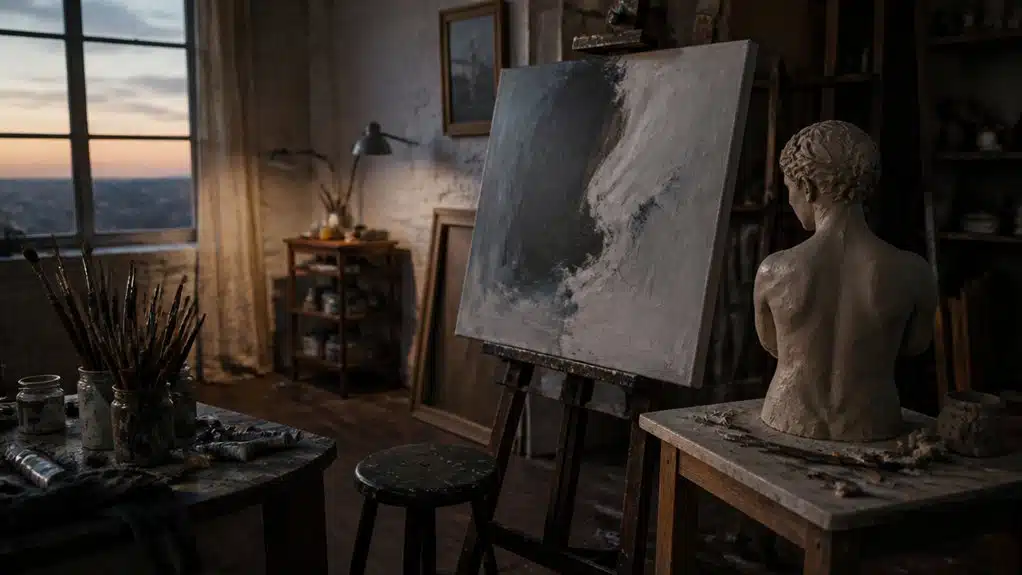
There is a moment— quietly, suddenly, irrevocably – when the screen stops demanding more and simply *speaks*.
No negotiation. No revisions. Just the truth, raw and final, stretched over patent leather and painted linen.
I don't decide when a BrandArt-piece is finished.
My work tells me so. A Louis Vuitton monogram stops resisting the brushstroke.
The monogram doesn't give in—it surrenders. And in this surrender, the brushstroke finally finds its place.
A Hermès silhouette blends into the surrounding field of color as if it had always been meant to belong there.
Prada's geometry falls into place. Dior takes a breath.
Perfection is not the absence of imperfection—it is the presence of inevitability.
When I step back and no longer feel anything pulling me forward, that's the sign.
The item no longer belongs to a brand. It belongs to itself. The person who will be wearing it.
This silence—this inner peace—is not emptiness.
It's about arriving. The Street Meets the Gallery. The signature is in. The work is done.
Finishing a piece doesn't mean it's complete—it opens everything, something the viewer hasn't seen yet. The work takes on a different life as soon as it leaves my hands— unpredictable, lively, ready to make a difference, which I never intended to do. That's what this is all about.
A Louis Vuitton-A monogram embroidered on raw canvas, a Hermès clasp in the gallery light, a Prada silhouette against an asphalt background—none of it fades away. It poses a question.
That's what the open ending gives us:
Dior doesn't explain itself. Neither does a finished BrandArt piece. Restraint is a form of generosity. Mystery is the last remaining luxury.

What I was looking for was never the answer—it was the moment the answer arrives, irrevocable, earned and alive within you. That is the only ending worth having. Not the one handed to you like a receipt, but the one that is slowly setting out, just as light falls on a Hermès Leather hits you and reveals something you weren't prepared for.
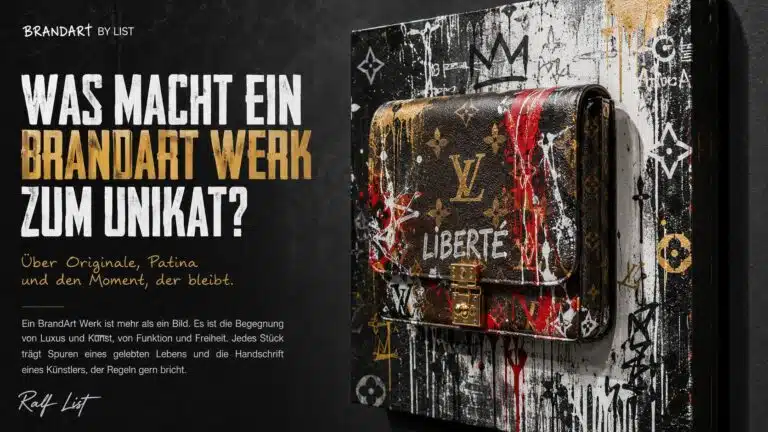
BrandArt by LIST cannot be explained in advance. It moves—across asphalt and hardwood floors, through Louis Vuitton, reborn on canvas, through Prada and Dior, stripped of their aloofness and made dangerous once again. Every 1/1 piece derives its significance from interaction, not from instruction.
I want the revelation. The texture, the tension, the twist. I want to stand before something and feel how logic catches up—precise, undeniable. That’s not consumption. That’s transformation. And true transformation, true transformation, can't be spoiled. It can only be experienced.
Every BrandArt piece takes shape at its own pace—sometimes in a matter of hours, sometimes over the course of weeks. I let the process guide me, not the plan. That’s exactly what brings it to life.
I tend to reach for Acrylic paint – because it makes colors shine and preserves their intensity for years. For me, color is not a matter of chance, but a deliberate means of evoking emotions.
Yes—sometimes I stand at markets and paint right in front of you. No screen, no finished painting. You see something take shape before I even realize it myself. It doesn’t get any more authentic than that.
I can't give you an exact number—that information isn't publicly documented. What I can tell you is this: Each piece is intentionally created as a one-of-a-kind work, not as part of mass production. Quality trumps quantity.
Yes—just as Tolstoy continually reshaped *War and Peace*, List also revises his works after the fact or discards them entirely. No piece is sacrosanct. What isn’t right is changed—or let go.
I don't chase resolutions—I chase Revelations. Picasso once said that he didn't search, he found; I experience this truth every time I Hermès Leather It meets raw pigment, and something emerges that none of us planned. The end isn't the point. The transformation is. BrandArt isn't a complete sentence—it's an open-ended question, worn on the body, carried out into the streets. Join the movement. Leave the blueprint behind.
 German German
  English
 Spanish
 French